
AP SSC Biology Answer Key 2026 LIVE: Unofficial Key by Subject Expert; Paper Difficulty Level

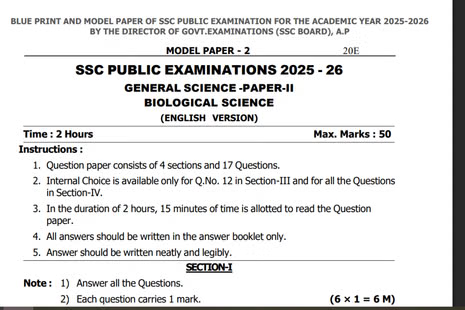
The AP SSC Biology Exam 2026 is on March 28, for 50 marks in 2 hours. Through this live blog, you can check the unofficial answer key prepared by subject expert along with the detailed question paper analysis that includes difficulty level details.
Key Event
-
12 mins ago
AP SSC Biology Exam 2026 Begins Smoothly Across the State
-
47 Minute ago
Final Checklist Before Leaving for Exam Centre
-
1 hour ago
Preparation Wrap-Up: Final Checklist Before Ending Study Session
-
1 hour ago
Section IV (8-Mark Questions): Structured Answers with Complete Explanation
-
2 hour ago
Section III (4-Mark Questions): Explanation with Diagrams for Full Marks
-
3 hour ago
Section II (2-Mark Questions): Short, Clear and Point-Wise Answers
-
4 hour ago
Section I (1-Mark Questions): Precision and Accuracy is Key
-
5 hour ago
Explain Importance of Variation in Organisms
AP SSC Biology Answer Key 2026: AP SSC Biology Exam 2026 is being conducted on March 28. There will be a variety of questions in the question paper, including objective questions, short answers, and long descriptive answers. The major chapters included in the exam are Life Processes, Control and Coordination, Reproduction, Heredity, and Our Environment. Through this live blog, students can download the unofficial answer key along with the detailed question paper analysis. The answer key for Biology is being prepared and shared by the Counseling Shortcuts subject expert after 11:30 AM.
AP SSC Biology Answer Key 2026 (Unofficial)
- Answer key will be updated here after 11:30 AM
AP SSC Biology Exam 2026 Quick Facts
Some of the details and facts related to the AP SSC Biology Exam 2026 can be found below –
| Aspect | Details |
|---|---|
| Exam Date | March 28, 2026 |
| Exam Duration | 2 Hours |
| Sections | Section I, II, III & IV |
| Questions Pattern |
|
| Max Marks | 50 Marks |
Also read | AP SSC Result 2026 Release Date Prediction
With the AP SSC Biology Exam 2026 around the corner, students must focus on high-weightage topics such as Life Processes, Reproduction, and Heredity, and practice diagrams and structured answers. Students must make an effort to write answers with clear points, proper labelling, and examples to obtain full marks. Students must keep revising and follow updates from Counseling Shortcuts LIVE to confidently face the exam and obtain high scores.
AP SSC Biology Exam 2026 LIVE:
09 30 AM IST - 28 Mar'26
AP SSC Biology Exam 2026 Begins Smoothly Across the State
The AP SSC Biology Exam 2026 has officially commenced across all centres in a smooth and disciplined manner. The question papers were distributed on time, and candidates began attempting the paper without any delay.
08 55 AM IST - 28 Mar'26
Final Checklist Before Leaving for Exam Centre
As the AP SSC Biology Exam 2026 day begins, candidates across Andhra Pradesh are preparing to leave for their exam centres. It is essential to ensure all required items are carried to avoid last-minute issues.
- Hall ticket (mandatory)
- Blue/black pens, pencils, eraser
- Geometry tools (if required)
- Transparent pouch
- Water bottle (as per guidelines)
Authorities advise candidates to reach the centre early and avoid carrying prohibited items such as electronic gadgets.
08 15 AM IST - 28 Mar'26
Preparation Wrap-Up: Final Checklist Before Ending Study Session
Students are completing their preparation by organizing notes and ensuring all important topics have been covered.
- Revise diagrams once
- Check important definitions
- Keep study material ready
This step ensures a smooth transition into exam day preparation.
07 45 AM IST - 28 Mar'26
Section IV (8-Mark Questions): Structured Answers with Complete Explanation
Section IV is the most important part of the paper and requires well-structured long answers.
- Follow structure:
- Introduction
- Explanation (in points)
- Diagram (if needed)
- Conclusion
- Write answers in paragraph + bullet format
- Use headings for clarity
- Ensure all key points are covered
This section carries maximum marks, so proper presentation and complete explanation are essential.
- Follow structure:
07 10 AM IST - 28 Mar'26
Section III (4-Mark Questions): Explanation with Diagrams for Full Marks
Section III answers should include detailed explanation along with diagrams wherever applicable. This section tests understanding and presentation.
- Begin with a short introduction
- Write answers in points or steps
- Include neat, labeled diagrams (if required)
- Highlight key terms and headings
Combining theory and diagrams improves answer quality and increases chances of scoring maximum marks.
06 15 AM IST - 28 Mar'26
Section II (2-Mark Questions): Short, Clear and Point-Wise Answers
Section II requires brief explanations, so answers should be written in 2–3 meaningful points. Avoid writing long paragraphs and focus on clarity.
- Start with a definition or key point
- Add 1–2 supporting points or examples
- Maintain neat handwriting and spacing
- Underline important keywords
Writing concise answers helps save time and ensures better presentation, which is important for scoring full marks.
05 10 AM IST - 28 Mar'26
Section I (1-Mark Questions): Precision and Accuracy is Key
In Section I, questions are direct and require very short answers, so students must focus on accuracy rather than length. Answers should be written in one clear line, avoiding unnecessary explanations.
- Write only the exact definition or term
- Avoid overwriting or extra sentences
- Use correct scientific terms (e.g., “chlorophyll,” not “green substance”)
- Read the question carefully before answering
This section is highly scoring, and even small mistakes like spelling errors can lead to loss of marks.
04 15 AM IST - 28 Mar'26
Explain Importance of Variation in Organisms
Variation refers to differences among individuals of the same species. It is important for survival, as it helps organisms adapt to changing environments. Variations increase the chances of survival during environmental changes or natural selection. They also lead to evolution and development of new species. Without variation, species would not be able to survive long-term changes.
03 10 AM IST - 28 Mar'26
Draw and Explain Male Reproductive System
Answer:
Diagram labels:
- Testes
- Vas deferens
- Urethra
Explanation:
The male reproductive system produces and transports male gametes. Testes produce sperms, which travel through the vas deferens and are released through the urethra. This system is essential for reproduction and continuation of species.02 15 AM IST - 28 Mar'26
Short Notes Revision: Quick Recall Strategy
Now, it's time to revise the short notes, which include important points, diagrams, and definitions. This helps in quick recall and reduces confusion during the exam.
- Focus on key formulas and diagrams
- Avoid new topics
- Revise only important points
Short notes are highly effective for last-minute preparation.
01 10 AM IST - 28 Mar'26
What are Hormones? Explain their Functions
Hormones are chemical messengers secreted by endocrine glands. They travel through the bloodstream and regulate body functions such as growth, metabolism, and reproduction. For example, thyroxine controls metabolism, while insulin regulates blood sugar levels. Hormones act slowly but have long-lasting effects. They play a crucial role in maintaining coordination and balance in the body.
12 05 AM IST - 28 Mar'26
Draw and Explain Human Brain
Answer:
Diagram labels:
- Cerebrum
- Cerebellum
- Medulla
Explanation:
The brain is the control center of the body. The cerebrum controls thinking and voluntary actions, the cerebellum maintains balance and coordination, and the medulla controls involuntary activities such as breathing and heartbeat. Proper labeling is important to secure full marks.11 00 PM IST - 27 Mar'26
What is Ecosystem? Explain its Components
An ecosystem is a system formed by the interaction of living organisms and their environment. It consists of biotic components (plants, animals, microorganisms) and abiotic components (air, water, soil). Producers make food, consumers depend on them, and decomposers break down waste. Ecosystems maintain balance in nature and support life processes.
10 40 PM IST - 27 Mar'26
Top 30 One-Mark Questions & MCQs: 21–30
Environment & Control and Coordination
- What is ecosystem?
→ Interaction of living and non-living - What is food chain?
→ Transfer of energy - What is trophic level?
→ Each step in food chain - Who are producers?
→ Plants - Who are consumers?
→ Animals - What are decomposers?
→ Organisms that break waste - What is hormone?
→ Chemical messenger - Which organ controls body?
→ Brain - What is reflex action?
→ Quick automatic response - What is neuron?
→ Nerve cell
- What is ecosystem?
10 20 PM IST - 27 Mar'26
Top 30 One-Mark Questions & MCQs: 11–20
Reproduction & Heredity
- What is reproduction?
→ Process of producing offspring - What is fertilization?
→ Fusion of gametes - Which reproduction involves one parent?
→ Asexual reproduction - What is a gene?
→ Unit of heredity - What is DNA?
→ Genetic material - Who determines the sex of a child?
→ Father - What is variation?
→ Differences among organisms - What is mutation?
→ Sudden change in genes - What is chromosome?
→ Structure carrying genes - What is heredity?
→ Transfer of traits
- What is reproduction?
10 00 PM IST - 27 Mar'26
Top 30 One-Mark Questions & MCQs: 1–10
Life Processes (Highly Repeated)
- What is photosynthesis?
→ Process of food preparation in plants - Which gas is released during photosynthesis?
→ Oxygen - What is the function of stomata?
→ Gas exchange - Which pigment is required for photosynthesis?
→ Chlorophyll - What is respiration?
→ Breakdown of food to release energy - Where does digestion begin?
→ Mouth - Which enzyme digests proteins?
→ Pepsin - What is the function of xylem?
→ Transport water - What is the function of phloem?
→ Transport food - What is transpiration?
→ Loss of water from leaves
- What is photosynthesis?
09 40 PM IST - 27 Mar'26
Explain Fertilization in Flowering Plants
Fertilization in flowering plants occurs after pollination, when pollen grains reach the stigma. The pollen tube grows through the style and reaches the ovule. The male gamete fuses with the female gamete to form a zygote. This process leads to the formation of seeds and fruits. Fertilization is essential for reproduction and continuation of plant species.
09 20 PM IST - 27 Mar'26
FINAL GUESS PAPER: Section IV – 8 Marks (Top 10 Expected)
- Explain photosynthesis experiment
- Explain transport system in humans
- Explain nervous vs hormonal system
- Explain reproduction in plants
- Explain heredity and variation
- Explain environmental pollution
- Explain waste disposal methods
- Explain control and coordination
- Explain food chain and energy flow
- Explain human digestive system
09 00 PM IST - 27 Mar'26
Draw and Explain Human Digestive System
Answer:
Diagram labels:
- Mouth
- Esophagus
- Stomach
- Liver
- Small intestine
- Large intestine
Explanation:
The digestive system breaks down food into simpler substances. Digestion begins in the mouth, continues in the stomach with gastric juices, and completes in the small intestine with the help of enzymes and bile. Nutrients are absorbed in the small intestine, and waste is eliminated through the large intestine.09 00 PM IST - 27 Mar'26
FINAL GUESS PAPER: Section III – 4 Marks (Top 10 Expected)
- Explain photosynthesis
- Explain digestion in humans
- Draw and explain nephron
- Explain fertilization in plants
- Explain food chain
- Explain reflex action
- Differentiate reproduction types
- Explain ecosystem
- Explain hormones
- Explain waste management
08 40 PM IST - 27 Mar'26
Describe Structure and Function of Nephron
The nephron is the functional unit of the kidney responsible for filtration of blood. It consists of the glomerulus, Bowman’s capsule, tubule, and collecting duct. Blood is filtered in the glomerulus, useful substances are reabsorbed, and waste is excreted as urine. The nephron helps maintain water balance and removes toxic substances from the body, ensuring proper functioning of the excretory system.
08 20 PM IST - 27 Mar'26
FINAL GUESS PAPER: Section II – 2 Marks (Top 10 Expected)
- Define trophic level
- What is variation?
- Define reproduction
- What is fertilization?
- Define neuron
- What is endocrine gland
- Define digestion
- What is excretion
- Define adaptation
- What is respiration
08 00 PM IST - 27 Mar'26
Explain Digestion Process in Human Beings
Digestion in human beings begins in the mouth, where food is chewed and mixed with saliva. It then moves to the stomach, where gastric juices break down food further. In the small intestine, enzymes and bile help digest fats, proteins, and carbohydrates. Nutrients are absorbed into the bloodstream. The remaining waste passes to the large intestine and is eliminated. This process ensures proper nutrition and energy supply.
07 40 PM IST - 27 Mar'26
FINAL GUESS PAPER: Section I – 1 Mark (Very Short Answers)
- Define photosynthesis
- What is DNA?
- Define ecosystem
- What is hormone?
- Define gene
- What is reflex action
07 20 PM IST - 27 Mar'26
Draw and Explain Structure of Nephron
Answer:
Diagram (to be drawn in exam):
- Glomerulus
- Bowman’s capsule
- Tubule
- Collecting duct
Explanation:
The nephron is the structural and functional unit of the kidney. Blood enters the glomerulus where filtration takes place. Useful substances like glucose and water are reabsorbed in the tubule, while waste materials are passed into the collecting duct as urine. The nephron helps maintain water balance and removes harmful wastes from the body.07 00 PM IST - 27 Mar'26
What is DNA? Explain its Role
DNA (Deoxyribonucleic Acid) is the genetic material present in all living organisms. It carries hereditary information from parents to offspring. DNA contains genes, which control traits such as height, color, and structure. It plays a crucial role in cell division, growth, and development. DNA ensures continuity of species and helps in the transmission of characteristics across generations.
06 40 PM IST - 27 Mar'26
Explain Photosynthesis Process
Photosynthesis is the process by which green plants prepare their own food using sunlight, carbon dioxide, and water in the presence of chlorophyll. It takes place mainly in the leaves. During this process, light energy is converted into chemical energy. The simplified equation is:
CO₂ + H₂O → Glucose + O₂.
Oxygen is released as a by-product. This process is essential for maintaining oxygen balance and supporting life on Earth.06 20 PM IST - 27 Mar'26
Top Questions with Answer Writing Structure
Focus not just on questions but also on how to present answers effectively.
- 2-mark → definition + example
- 4-mark → explanation + diagram
- 8-mark → introduction + explanation + conclusion
Example:
- Photosynthesis answer must include:
- Definition
- Equation
- Process
This structured approach ensures maximum marks.
06 00 PM IST - 27 Mar'26
Top 10 Most Expected 8-Mark Questions (Long Answer Focus)
Top 10 high-weightage 8-mark questions, which are crucial for scoring high marks.
- Explain photosynthesis experiment
- Explain transport system in humans
- Explain nervous system vs hormonal system
- Explain reproduction in plants
- Explain heredity and variation
- Explain environmental pollution
- Explain waste disposal methods
- Explain human eye structure
- Explain control and coordination
- Explain food chain and energy flow
These questions require structured answers with headings.
05 45 PM IST - 27 Mar'26
Heredity: Variation and Its Importance
- Question: Why is variation important?
- Answer: Variation helps organisms survive in changing environments and ensures continuity of species
This is a concept-based question often asked in exams.
05 30 PM IST - 27 Mar'26
Environment: Ecosystem and Components
- Question: What is ecosystem?
Answer Points:
- Interaction of living and non-living components
- Includes producers, consumers, decomposers
This is a basic but important question.
05 15 PM IST - 27 Mar'26
Diagram + Theory Combined Practice for 4-Mark Questions
Practicing answers that combine both explanation and diagrams, which is a key requirement for scoring full marks in Section III.
- Nephron → structure + function
- Brain → diagram + functions
- Food chain → diagram + explanation
Writing answers with both diagram and theory ensures better presentation and helps in securing maximum marks.
05 00 PM IST - 27 Mar'26
Quick Definitions Revision: Securing Easy 1 & 2 Marks
Revise all important definitions, which are direct and highly scoring in the exam. This step is essential to ensure no easy marks are lost.
- Photosynthesis → food preparation process in plants
- Hormones → chemical messengers
- Ecosystem → interaction of living and non-living
- Gene → unit of heredity
Clear and precise definitions help in answering quickly and accurately under time pressure.
04 45 PM IST - 27 Mar'26
Top 10 Most Expected 4-Mark Questions
Top 10 important 4-mark questions, which require explanation along with examples or diagrams.
- Explain photosynthesis process
- Explain digestion in humans
- Draw and explain nephron
- Explain fertilization in plants
- Explain food chain
- Explain reflex action
- Differentiate asexual and sexual reproduction
- Explain ecosystem
- Explain role of hormones
- Explain waste management
04 30 PM IST - 27 Mar'26
Reproduction: Types and Differences (Important 4-Mark)
- Question: Differentiate asexual and sexual reproduction
Answer Points:
- Asexual → one parent, no variation
- Sexual → two parents, variation present
Such comparison questions are commonly asked and easy to score.
04 15 PM IST - 27 Mar'26
Control & Coordination: Reflex Action Concept
- Question: What is reflex action?
- Answer: It is an automatic and quick response to a stimulus without conscious thought
- Example:
- Touching a hot object
This concept is simple and often asked in exams.
04 00 PM IST - 27 Mar'26
Life Processes: Photosynthesis Explanation (4-Mark Focus)
- Question: Explain photosynthesis
Answer Points:
- Occurs in chloroplast
- Uses sunlight, CO₂, and water
- Produces glucose and oxygen
This is a frequently asked question and is considered highly scoring due to its predictable answer pattern.
03 45 PM IST - 27 Mar'26
Mixed Revision Block: Questions for Practice
A quick set of important questions to test their understanding across multiple chapters.
- Explain digestion process
- Define genes
- What is trophic level?
- Draw nephron diagram
- Explain fertilization in plants
This type of revision helps improve recall speed and confidence before the exam.
03 30 PM IST - 27 Mar'26
Section IV Focus: 8-Mark Question
- Question: Prove that carbon dioxide is necessary for photosynthesis
Answer Points:
- Experimental setup with plant
- Removal of CO₂
- No starch formation observed
Such experimental questions are highly expected and require step-wise explanation.
03 15 PM IST - 27 Mar'26
Section II Focus: Important 2-Mark Questions with Answers
- Question: What are hormones?
- Answer: Hormones are chemical messengers secreted by endocrine glands that regulate body functions.
- Question: Define ecosystem
- Answer: A system formed by interaction of living and non-living components
These questions are easy scoring and commonly asked.
03 00 PM IST - 27 Mar'26
Mixed High-Weightage Revision: Life Processes, Reproduction, Heredity
All high-weightage chapters together to strengthen retention and recall before the exam.
- Focus areas:
- Photosynthesis and digestion
- Fertilization and reproduction types
- DNA and heredity concepts
This combined revision helps in connecting topics and preparing for application-based questions across different sections.
- Focus areas:
02 45 PM IST - 27 Mar'26
Waste Management: Composting vs Burning
- Question: Which is better: composting or burning?
Answer Points:
- Composting: eco-friendly, produces manure
- Burning: causes pollution and releases harmful gases
Students should justify answers with proper reasoning, as evaluation focuses on clarity and logical explanation.
02 30 PM IST - 27 Mar'26
Environment: Trophic Levels and Food Chain Explanation
Environmental concepts, especially food chains, which are commonly asked in both diagram and theory-based questions.
- Question: What are trophic levels?
- Answer: Each step in a food chain is called a trophic level.
- Example:
- Grass → Deer → Tiger
This topic is important as it is simple, scoring, and frequently repeated in exams.
02 15 PM IST - 27 Mar'26
Heredity: DNA, Genes and Traits (Core Concept Revision)
Fundamental concepts from Heredity, which are essential for answering both short and long questions effectively.
- Question: What is DNA?
- Answer: DNA is the genetic material that carries hereditary information from parents to offspring.
- Key points:
- Genes are segments of DNA
- Traits are expressed through genes
Understanding this concept helps in answering analytical questions in exams.
02 00 PM IST - 27 Mar'26
Control & Coordination: Nervous vs Hormonal System (Important 4/8 Mark Question)
- Question: Compare nervous and hormonal control systems
Answer Points:
- Nervous system: fast, electrical signals, short-lasting effect
- Hormonal system: slow, chemical signals, long-lasting effect
- Nervous uses neurons; hormonal uses glands
This question is highly expected as it tests conceptual understanding and comparison skills.
01 45 PM IST - 27 Mar'26
Top 20 Most Expected 2-Mark Questions (High Scoring Block)
Revise the Top 20 most expected 2-mark questions, which are highly scoring and frequently asked in exams. These questions require short, precise answers and help secure marks quickly.
- Define photosynthesis
- What is transpiration?
- Define hormones
- What is DNA?
- Define gene
- What is ecosystem?
- Define trophic level
- What is variation?
- Define reproduction
- What is fertilization
- Define reflex action
- What is heredity
- Define mutation
- What is food chain
- Define neuron
- What is endocrine gland
- Define respiration
- What is digestion
- Define excretion
- What is adaptation
These questions are repeatedly seen in previous papers and model papers.
01 30 PM IST - 27 Mar'26
Life Processes: Photosynthesis Lab Activity (8-Mark Focus)
Revising long-answer experimental questions.
- Question: Prove CO₂ is necessary for photosynthesis
Answer Points:
- Setup experiment
- Remove CO₂
- Observe no starch formation
This is a high-probability 8-mark question.
01 15 PM IST - 27 Mar'26
Reproduction: Fertilization in Plants (4-Mark)
- Question: Explain fertilization in flowering plants
Answer Points:
- Pollination occurs
- Pollen tube formation
- Fusion of gametes
- Seed formation
This question is frequently asked.
01 00 PM IST - 27 Mar'26
Midday Revision: Focus on Diagrams and Definitions
Revise diagrams and key definitions, which are easy scoring areas.
- Diagrams:
- Nephron
- Human brain
- Reproductive system
- Definitions:
- Photosynthesis
- Hormones
- Ecosystem
This phase helps strengthen memory.
- Diagrams:
12 45 PM IST - 27 Mar'26
Frequently Asked Questions
- Explain photosynthesis process
- What is trophic level?
- Define hormones
- Draw nephron diagram
- Explain fertilization
12 30 PM IST - 27 Mar'26
Awareness-Based Question: Environmental Protection
Prepare answers that include awareness creation.
- Important question:
- How will you create awareness about plastic usage?
Answer Points:
- Conduct awareness programs
- Use eco-friendly alternatives
- Educate public
Such questions require practical and logical answers.
- Important question:
12 15 PM IST - 27 Mar'26
Environment: Plastic Pollution Question (4 Marks)
- Question: What problems arise due to plastic dumping?
Answer Points:
- Water pollution
- Harm to aquatic life
- Soil pollution
12 00 PM IST - 27 Mar'26
Heredity: Variation and Survival Concept
Revise concept-based questions from Heredity.
- Important question:
- Why are variations important?
Answer:
Variations help organisms survive in changing environments, increasing chances of survival.This concept is often asked in analytical questions.
- Important question:
11 45 AM IST - 27 Mar'26
Reproduction: Asexual Reproduction Types (1 & 2 Mark Focus)
Types of asexual reproduction.
- Types:
- Binary fission
- Budding
- Spore formation
- Important question:
- Identify reproduction type from diagram
This is a common MCQ or short-answer question in exams.
- Types:
11 30 AM IST - 27 Mar'26
Control and Coordination: Hormones Table-Based Question
Focus on table-based questions, which are often asked in Section II.
- Example:
- Thyroxine → Thyroid gland → Controls metabolism
- Estrogen → Ovaries → Female characteristics
- Possible question:
- Identify gland responsible for puberty changes
These questions test understanding and are easy to score.
- Example:
11 15 AM IST - 27 Mar'26
2-Mark Question: Digestion of Fats in Humans
- Question: Explain digestion of fats in human beings
Answer Points:
- Bile breaks fats into small droplets
- Lipase enzyme digests fats into fatty acids and glycerol
This is a direct model paper question, making it highly reliable.
11 00 AM IST - 27 Mar'26
Diagram Practice: Nephron
Focus on the nephron diagram, which is directly mentioned in the model paper as an option-based question.
- Important parts:
- Glomerulus
- Bowman’s capsule
- Tubules
- Question:
- Draw and label nephron
Proper labeling and clear structure are essential, as diagrams carry significant marks in Section III.
- Important parts:
10 45 AM IST - 27 Mar'26
Life Processes: Transport System in Humans
Revise the transport system in human beings, a frequently asked 4-mark question from the model paper. This topic includes both explanation and components.
- Important question:
- What are the components of transport system in humans?
- Key points:
- Heart → pumps blood
- Blood → transports oxygen and nutrients
- Blood vessels → arteries, veins, capillaries
This question often appears with functions, making it important to write answers in structured points.
- Important question:
10 30 AM IST - 27 Mar'26
Final High-Weightage Topics Revision
Revise the most important chapters again:
- Life Processes (14 marks)
- Reproduction (10 marks)
- Heredity (10 marks)
These chapters carry maximum weightage as per blueprint and are essential for scoring high marks. Students are focusing on key questions, diagrams, and definitions for quick recall.
10 15 AM IST - 27 Mar'26
Most Important Questions
A set of important questions across chapters:
- Define photosynthesis
- Explain nephron structure
- What is DNA?
- Define food chain
- What are hormones?
- Explain reproduction types
This type of revision helps cover multiple chapters quickly.
10 00 AM IST - 27 Mar'26
Diagram Practice: Human Brain with Labeling
Focus on brain diagram, which is a commonly asked diagram in exams.
- Key parts:
- Cerebrum
- Cerebellum
- Medulla
Proper labeling and neat diagram presentation are important for scoring full marks. This question may appear in 4-mark section
- Key parts:
09 45 AM IST - 27 Mar'26
2-Mark Question: Hormones and Their Functions
- Question: What are hormones?
- Answer:
Hormones are chemical messengers secreted by endocrine glands that regulate body functions. - Example:
- Thyroxine → Controls metabolism
- Estrogen → Female reproductive functions
These questions are frequently asked in Section II.
09 30 AM IST - 27 Mar'26
Control and Coordination: Important Topics for Revision
Control and Coordination, which includes both nervous system and hormones.
- Key areas:
- Brain functions
- Hormones and glands
- Reflex actions
- Important question:
- Difference between nervous and hormonal control
This chapter is important for both short answers and long answers.
- Key areas:
09 15 AM IST - 27 Mar'26
Waste Management: 4-Mark Question with Answer Points
Environmental issues and waste management are commonly asked questions.
- Question: Explain methods of waste disposal
Answer Points:
- Composting → Converts waste into manure
- Recycling → Reuse of materials
- Burning → Not eco-friendly
Students should write advantages and disadvantages to improve answer quality.
09 00 AM IST - 27 Mar'26
Food Chain Diagram and Explanation (High Scoring)
Students are practicing diagram-based questions from Environment chapter, especially food chain diagrams, which are frequently asked.
- Example diagram:
- Grass → Deer → Tiger
- Key points:
- Energy flows from producers to consumers
- Each level is called trophic level
This question may appear in 2-mark or 4-mark format and is considered highly scoring.
- Example diagram:
08 45 AM IST - 27 Mar'26
Environment Chapter: Important Definitions and Concepts
Revice Our Environment, which is a scoring and theory-based chapter with direct questions.
- Important questions:
- What is ecosystem?
- Define food chain
- What are trophic levels?
These questions are usually asked in Section I and II, making them easy to attempt and score marks quickly.
- Important questions:
08 30 AM IST - 27 Mar'26
4-Mark Question Practice: Mendel’s Laws of Inheritance
Students have to revise Mendel’s Laws, which are key conceptual questions in Heredity.
- Question: Explain Mendel’s laws of inheritance
Answer Points:
- Law of dominance → One trait dominates
- Law of segregation → Traits separate during gamete formation
These answers should be written in point-wise format with clear explanation for better scoring.
08 15 AM IST - 27 Mar'26
Most Repeated Question: Role of Father in Determining Sex
One of the most commonly asked questions from Heredity is about sex determination, and it appears almost every year in exams.
- Question: Why is father responsible for determining the sex of a child?
- Answer:
The father produces two types of gametes (X and Y), while the mother produces only X gametes. If the father contributes X chromosome, the child is female; if Y, the child is male.
This concept is very important for 2-mark and 4-mark questions.
08 00 AM IST - 27 Mar'26
Heredity Chapter: Core Concepts and Frequently Asked Questions
Students are shifting their focus to Heredity, which is concept-driven and frequently asked in both short and long answers. Questions often revolve around genes, chromosomes, and inheritance patterns.
- Important questions:
- What is heredity?
- Define variation
- What are genes?
- Concept:
- Traits are passed from parents to offspring through genes
This chapter is important for logical understanding and application-based questions.
- Important questions:
07 45 AM IST - 27 Mar'26
Diagram Focus: Male Reproductive System with Key Labeling Points
Students are now revising important diagrams from Reproduction chapter, as diagram-based questions are highly scoring in Biology exams. The male reproductive system is one of the most expected diagrams in Section III.
- Key parts to label:
- Testes
- Vas deferens
- Urethra
- Seminal vesicles
- Important question:
- Draw and label male reproductive system
Clear labeling and neat diagram presentation can help secure full marks even if explanation is brief.
- Key parts to label:
07 30 AM IST - 27 Mar'26
4-Mark Question: Reproduction in Flowering Plants
- Question: Explain fertilization in plants
Answer Points:
- Pollination occurs
- Pollen reaches ovule
- Fusion of gametes
- Seed formation
This is a frequently repeated question.
07 15 AM IST - 27 Mar'26
Reproduction: Key Definitions
Students are revising key definitions.
- Asexual reproduction → Single parent
- Sexual reproduction → Two parents
- Fertilization → Fusion of gametes
Focus:
- Clear definitions
- Differences between asexual & sexual reproduction
07 00 AM IST - 27 Mar'26
Reproduction Chapter: Most Expected Questions
Reproduction is another high-weightage and scoring chapter.
- Important questions:
- Types of asexual reproduction
- Explain fertilization in plants
- Describe male reproductive system
This chapter is often asked in both 2-mark and 8-mark formats.
- Important questions:
06 45 AM IST - 27 Mar'26
8-Mark Question Practice: Life Processes
Students are revising long-answer questions.
- Question: Explain the process of digestion in human beings
Answer Points:
- Mouth → stomach → small intestine
- Enzymes help digestion
- Absorption occurs in intestine
This is a very high probability 8-mark question.
06 30 AM IST - 27 Mar'26
Diagram Focus: Human Digestive System (Very Important)
Diagrams play a crucial role in scoring marks in Biology.
- Important diagram:
- Human digestive system
- Must include labeling:
- Mouth, stomach, liver, pancreas, intestines
Tip:
- Neat labeling can fetch extra marks even if explanation is short
- Practice quick sketching for exam speed
- Important diagram:
06 15 AM IST - 27 Mar'26
Important 2 Mark Questions from Life Processes with Answers
Students are now focusing on short-answer and descriptive questions.
- Question: What is photosynthesis?
Answer: It is the process by which green plants prepare food using sunlight, carbon dioxide, and water. - Question: Explain function of xylem and phloem
Answer: Xylem transports water; phloem transports food
These are frequently asked and easy scoring questions.
- Question: What is photosynthesis?
06 00 AM IST - 27 Mar'26
Early Morning Revision Begins: Life Processes (High Weightage Chapter)
Students are beginning their revision with Life Processes, one of the most scoring chapters in the Biology exam. This chapter frequently contributes questions across all sections, especially diagrams and 4-mark answers.
- Important questions:
- Explain digestion process in human beings
- Describe transportation in plants
- Key concept:
- Nutrition → Respiration → Transportation → Excretion
Quick revision of diagrams like digestive system and nephron is highly recommended.
- Important questions:
Do you have a question? Ask us.
- Typical response between 24-48 hours
- Get personalized response
- Free of Cost
- Access to community