
CBSE Class 12 Biology Answer Key 2026 (OUT) LIVE: Unofficial Key by Subject Expert; Paper Difficulty Level

CBSE Class 12 Biology Answer Key 2026 prepared by subject expert has been shared here through live blog along with the question paper difficulty level details.
Key Event
-
20 hour ago
Pens Down: Final Review And Submission
-
21 hour ago
The Final Push: Section E And Diagram Labeling
-
22 hour ago
Tackling Section D: The Case-Study Challenge
-
23 hour ago
Deep Into Section A: The Precision Phase
-
23 hour ago
The Clock Strikes: CBSE 12 Biology Exam 2026 Officially Begins
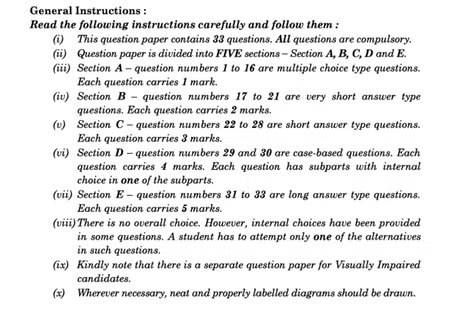
CBSE Class 12 Biology Answer Key 2026: The Class 12th Biology 2026 (Subject Code-044) paper was successfully held on March 27, 2026, from 10:30 AM to 1:30 PM. The 33 questions on the paper were worth 70 marks in total. A, B, C, D and E were the five sections in the test. 50% of the questions were centred on concept-based topics, such as assertion-reasoning and case studies. Through this live blog, you can check the unofficial answer key prepared and shared by Counseling Shortcuts Biology subject expert Samiksha Rautela, along with the paper difficulty level details. The key and student reactions will be shared here soon.
CBSE Class 12 Biology Answer Key 2026 (Unofficial)
The unofficial answer key of CBSE Class 12 Biology is provided below:
SET 57/1/1
| Q. No. | Question | Correct Answer |
|---|---|---|
| 1 | Identify the plant in which emasculation is not required for artificial hybridization. | (D) Papaya (It is dioecious/unisexual) |
| 2 | Which of the following is not a component of immune system? | (C) Red Blood Cells |
| 3 | Select the correct statements: (i) Corpus luteum secretes progesterone. (ii) Only FSH peaks mid-cycle. (iii) LH surge induces rupture of graafian follicle. (iv) Luteal phase is also called proliferative phase. | (B) (i) and (iii) are correct. |
| 4 | Select the mismatched pair. | (B) Genetically different strains of rice in India – Less than 1000 (Actually >50,000) |
| 5 | Pomato was produced by fusing protoplasts of: | (A) Tomato and Potato |
| 6 | Vertical distribution of species in an ecosystem is called: | (A) Stratification |
| 7 | Which sacred grove is found in Meghalaya? | (A) Jaintia Hills |
| 8 | Two ways of pairing of homologous chromosomes show which phenomenon? | (B) Independent assortment |
| 9 | Match Column-I with Column-II (Biolistic gun, Chitinase, Ti, Ca++). | (C) a-v, b-iv, c-ii, d-i |
| 10 | The idea of use and disuse of organs was proposed by: | (D) Lamarck |
| 11 | Incorrect statement about plasmids: | (B) Replication controlled by chromosomal DNA |
| 12 | Connective tissue linking ovary to pelvic wall and uterus: | (B) Ligaments |
| 13 | Assertion: Melanized moths increased in industrial areas. Reason: Soot provided camouflage. | (A) Both true and correct explanation |
| 14 | Assertion: Transgenic cow Rosie’s milk was nutritionally better. Reason: Contained α-lactalbumin. | (A) Both true and correct explanation |
| 15 | Assertion: Flocs are bacteria + fungal filaments. Reason: They use anaerobic respiration. | (C) Assertion true, Reason false (aerobic) |
| 16 | Assertion: Grazing food chain dominates terrestrial ecosystems. Reason: Linked to detritus chain. | (D) Assertion false, Reason true |
CBSE Class 12 Biology Paper Analysis 2026
As per the initial reactions by students, the Biology CBSE Class 12th exam was of a ‘Moderate’ difficulty level. Some felt the exam was lengthy, while others said that the exam was entirely NCERT-based. MCQs were simple, but case-based and assertion-reasoning questions required conceptual clarity. Students found the application-based questions challenging. According to them, the Diagrams asked in the test were tricky, and time management was the key to completing the exam on time.
CBSE Class 12 Biology Exam 2026 Quick Facts
Here are some quick facts on CBSE Class 12 Biology Exam 2026:
| Particulars | Details |
|---|---|
| CBSE Class 12 Biology Exam Date | March 27, 2026 |
| Exam Timing | 10:30 AM to 1:30 PM |
| Number of Sections | 5 Sections – A, B, C, D, and E |
| Type of Questions | MCQs, Very Short Answer, Short Answer, Long Answer, Case-based/Source-based |
| Number of Questions |
|
| Marks per Question |
|
| Total Weightage |
|
| Passing Percentage | 33% |
CBSE Class 12 Biology Exam 2026 Live Updates
02 00 PM IST - 27 Mar'26
Answer key released
CBSE Class 12 Biology Answer Key 2026 has been released! Students can verify the correct responses with their answers and get an idea about their predicted scores.
01 45 PM IST - 27 Mar'26
Exam Moderate and Lengthy
As per the student reactions, the CBSE Class 12 Biology Exam 2026 was entirely NCERT-based. The exam turned out to be Moderate in difficulty level and was lengthier than expected!
01 30 PM IST - 27 Mar'26
Pens Down: Final Review And Submission
The 2026 Biology paper is officially over! Before handing over your sheet, quickly scan for your Roll Number and ensure all supplementary sheets are tied securely.
The "Check": Did you attempt all compulsory questions? Even if a question was difficult, providing a relevant diagram or keyword can often fetch you partial marks.
01 00 PM IST - 27 Mar'26
The Final Push: Section E And Diagram Labeling
With 30 minutes left, you should be wrapping up the 5-mark questions.
Quality Check: Ensure your diagrams are neat. Use a pencil for the drawing and a pen for the labels.
Key Areas: If you are answering a question on Double Fertilization, make sure to clearly label the Zygote and the Primary Endosperm Nucleus (PEN).
12 00 PM IST - 27 Mar'26
Tackling Section D: The Case-Study Challenge
You are likely facing the two Case-Based questions now. These are 4 marks each and usually involve a paragraph or a graph.
- Advice: Read the questions before reading the paragraph. This helps you hunt for specific data points, such as VNTR sequences in DNA fingerprinting or Population growth curves (r and K values).
11 00 AM IST - 27 Mar'26
Deep Into Section A: The Precision Phase
You should be finishing the 16 MCQs and Assertion-Reasoning questions now.
Warning: Do not rush these. In Assertion-Reason questions, check if the "Reason" is the correct explanation by using the word "because" between the two statements.
Time Check: You should ideally spend no more than 30–35 minutes on Section A to save time for the 5-mark long answers.
10 30 AM IST - 27 Mar'26
The Clock Strikes: CBSE 12 Biology Exam 2026 Officially Begins
The wait is over as thousands of students across the country break the seals of their question papers. With the invigilators announcing the start of the three-hour writing period, the focus now shifts to Time Management and Sectional Strategy.
Initial Paper Scan: Early reports suggest the paper opens with Section A, featuring 16 Objective Type questions. Students are advised to spend no more than 2 minutes per MCQ to stay on track for the lengthier 5-mark descriptions later.
10 00 AM IST - 27 Mar'26
Entering The Examination Hall: Mental Priming
The next 15 minutes are for instructions. Use this time to settle your nerves.
- Instruction Reminder: You will have 33 questions to tackle in 180 minutes.
- Strategy: Mentally categorize the paper into "Easy," "Moderate," and "Thinker" questions. This allows you to secure the marks for what you know first, building confidence for the harder sections.
09 00 AM IST - 27 Mar'26
Heading To The Center: Hydration And Positivity
As you leave for the exam center, ensure your Admit Card and transparent stationery kit are in hand. Avoid last-minute "group studies" outside the gate, as this can trigger anxiety.
Pro-Tip: Sip water to keep your brain hydrated; even mild dehydration can affect your ability to solve complex Genetics pedigrees or logic-based questions.
08 00 AM IST - 27 Mar'26
Final Concept Check: Biotechnology Applications
Expect at least one application-based question on RNA Interference (RNAi) or Bt Cotton.
Recall:Meloidegyne incognita infects tobacco roots. RNAi involves silencing specific mRNA using a complementary dsRNA molecule.
Bt Cotton: Remember that the Cry protein is an inactive protoxin that becomes active only in the alkaline pH of the insect's gut.
07 00 AM IST - 27 Mar'26
The "Golden Hour" For Visual Memory
With only a few hours left, stop reading dense paragraphs. Shift your focus entirely to Visual Mnemonics. Briefly look at the diagram of the Antibody molecule (H2L2) and the Bioreactor systems.
Quick Tip: Ensure you can distinguish between a simple stirred-tank and a sparged stirred-tank bioreactor; the latter increases the surface area for oxygen transfer.
06 00 AM IST - 27 Mar'26
Hormonal Control: A Common 3-Mark Area
Quickly recall the roles of LH and FSH. Remember:
- LH Surge: Triggers Ovulation.
- FSH: Stimulates follicular development.
- Progesterone: Maintained by the Corpus Luteum to support the Endometrium.
05 00 AM IST - 27 Mar'26
The Final Wake-Up Call: Quick-Fire Revision
Good morning, future Biologists! Start your day with a "mental scan." Don't re-read entire chapters. Instead, look at the Summary pages at the end of each NCERT chapter. This triggers your memory without causing "information overload."
04 00 AM IST - 27 Mar'26
Focus On "The Big Three" Units
If you have 30 minutes, flip through these specific diagrams one last time:
- Genetics: Transcription unit and the Lac Operon.
- Reproduction: The human sperm and the 7-celled embryo sac.
- Biotech: The PCR steps (Denaturation, Annealing, Extension).
03 00 AM IST - 27 Mar'26
Visualization Technique: The Exam Hall
Spend 5 minutes visualizing yourself opening the paper, seeing familiar questions like the pBR322 vector or DNA Replication, and writing calmly. Positive visualization reduces cortisol levels, preventing "blank-outs" during the actual exam.
02 00 AM IST - 27 Mar'26
Final Checklist: Don't Forget Your Admit Card
Before hitting the bed, double-check your transparent stationery pouch. Ensure you have:
- Original CBSE Admit Card.
- At least two blue ballpoint pens and one black pen for headings.
- A sharpened HB pencil, an eraser, and a 30cm ruler for those 5-mark diagrams.
01 00 AM IST - 27 Mar'26
The Importance Of Sleep For Memory Consolidation
Scientific studies show that "Rapid Eye Movement" (REM) sleep is essential for turning short-term facts into long-term memory. If you are still awake, close your books now. Your brain needs at least 5–6 hours of rest to handle the 50% competency-based questions that require sharp analytical thinking.
12 00 AM IST - 27 Mar'26
The "Shut Down" Protocol
Your brain needs sleep to process the day's information (Memory Consolidation).
Pack your bag: Admit Card, pens, pencils, eraser, ruler, and a water bottle.
Set two alarms.
Final Thought: You’ve covered the entire syllabus today. Trust your hard work. You are ready!
11 00 PM IST - 26 Mar'26
Exam Hall Logic: Reading The Question Correctly
Many students lose marks on "Identify the Incorrect statement" or "Which is Not a function of..." questions. Use your pen to circle these "negative" words in the question paper during the 15-minute reading time.
10 40 PM IST - 26 Mar'26
Megasporogenesis vs. Microsporogenesis
- Micro (Male): All four microspores in a tetrad are functional.
Mega (Female): Only one megaspore remains functional; the other three degenerate. This leads to the "Monosporic development" of the embryo sac.
10 20 PM IST - 26 Mar'26
Final Assertion-Reason Checklist
Remember the "Because" rule. If Statement A is: "Pollen grains can be preserved as fossils," and Statement R is: "Sporopollenin is a highly resistant organic material," join them: "...preserved as fossils because sporopollenin is highly resistant." If it makes sense, mark (a).
10 00 PM IST - 26 Mar'26
The Hardy-Weinberg Principle
Equation: p2 + 2pq + q2 = 1.
If the frequency of alleles deviates from this, it indicates that Evolution is occurring. Factors affecting this include Mutation, Genetic Drift, and Natural Selection.
09 40 PM IST - 26 Mar'26
Microbes: The Industrial "Big Three"
- Statins: Produced by Monascus purpureus (Blood-cholesterol lowering agent).
Cyclosporin A: Produced by Trichoderma polysporum (Immunosuppressant).
Streptokinase: Produced by Streptococcus (Clot buster).
09 20 PM IST - 26 Mar'26
Evolution: Homology vs. Analogy
- Homologous Organs: Same structure, different function (e.g., Whale flippers and Human hand). Indicates Divergent Evolution.
Analogous Organs: Different structure, same function (e.g., Sweet potato/root and Potato/stem). Indicates Convergent Evolution.
09 00 PM IST - 26 Mar'26
Reproductive Health: IUDs (Intrauterine Devices)
Identify the three types:
Non-medicated: Lippes loop.
Copper-releasing: CuT, Cu7, Multiload 375 (suppress sperm motility).
Hormone-releasing: Progestasert, LNG-20 (make uterus unsuitable for implantation).
08 40 PM IST - 26 Mar'26
Molecular Basis: DNA Fingerprinting Steps
1. Isolation → 2. Digestion → 3. Electrophoresis → 4. Blotting → 5. Hybridization (using VNTR probe) → 6. Autoradiography.
Application: Used in forensic science and to determine paternity.
08 20 PM IST - 26 Mar'26
Section D Drill: Case-Study Analysis
Case studies usually come from Biotechnology (GMOs) or Ecology (Global Warming).
Strategy: Read the passage twice. Often, the answer to the first two sub-questions is hidden in the text, while the third requires your conceptual knowledge.
08 00 PM IST - 26 Mar'26
Biodiversity: In-Situ vs. Ex-Situ Conservation
- In-Situ (On-site): National Parks, Sanctuaries, Biosphere Reserves, and Sacred Groves.
Ex-Situ (Off-site): Zoological Parks, Botanical Gardens, Seed Banks, and Cryopreservation.
07 40 PM IST - 26 Mar'26
Population Attributes: Expanding vs. Declining
Look at the Age Pyramids.
Expanding: Large base of pre-reproductive individuals (triangular).
Stable: Pre-reproductive and reproductive stages are almost equal (bell-shaped).
Declining: Fewer pre-reproductive individuals (urn-shaped).
07 20 PM IST - 26 Mar'26
Ecology: The Pyramid Of Energy
Why is the Pyramid of Energy always upright? Because energy is lost as heat at every trophic level (10% Law).
Note: Pyramids of Biomass or Numbers can be inverted (e.g., Biomass in a sea/ocean), but Energy never is.
07 00 PM IST - 26 Mar'26
Cancer Biology: Contact Inhibition
Normal cells show Contact Inhibition, which stops their growth when they touch other cells. Cancer cells lose this property, leading to uncontrolled division and the formation of Tumors (Benign vs. Malignant).
06 40 PM IST - 26 Mar'26
The Life Cycle Of HIV (Retrovirus)
Focus on the role of Reverse Transcriptase. The virus uses this enzyme to convert its RNA genome into viral DNA, which then integrates into the host's (Helper T-cell) genome to produce more viral particles.
06 20 PM IST - 26 Mar'26
Human Health: Active vs. Passive Immunity
- Active: Your own body produces antibodies (Slow, but long-lasting; e.g., after a natural infection).
Passive: Ready-made antibodies are injected (Fast, but short-lived; e.g., Colostrum/IgA or Anti-tetanus serum).
06 00 PM IST - 26 Mar'26
The Molecular Scissors: Restriction Enzymes
Restriction enzymes (like EcoRI) recognize Palindromic sequences.
Mechanism: They cut the sugar-phosphate backbone slightly away from the center of the palindrome, leaving Sticky Ends. These ends allow DNA Ligase to easily join the foreign DNA to the vector.
05 40 PM IST - 26 Mar'26
Biotechnology: The PCR Protocol
You must know the temperature-dependent steps of the Polymerase Chain Reaction:
Denaturation (94 °C): Separation of DNA strands.
Annealing (52 °C): Primers bind to the DNA.
Extension (72 °C):Taq Polymerase synthesizes the new strand.
05 20 PM IST - 26 Mar'26
Genetic Crosses: Beyond Mendel
Review Incomplete Dominance (Snapdragon pink flowers) and Co-dominance (ABO Blood grouping).
Multiple Allelism: The I gene has three alleles: $I^{A}$, $I^{B}$, and $i$. This is a classic example of how more than two alleles can govern a single character in a population.
05 00 PM IST - 26 Mar'26
Comparison: Spermatogenesis vs. Oogenesis
Expect a 3-mark "Distinguish Between" question here.
- Spermatogenesis: Continuous, results in 4 equal-sized motile sperm.
- Oogenesis: Discontinuous (starts at fetal stage, stops at prophase-I), results in 1 large ovum and tiny polar bodies.
04 40 PM IST - 26 Mar'26
Understanding The Lac Operon "Switch"
In the presence of an inducer (Lactose), the repressor protein is inactivated. This allows RNA Polymerase access to the promoter, initiating the transcription of z, y, and a genes.
Key Enzyme:beta-galactosidase (from z-gene) breaks lactose into glucose and galactose.
04 20 PM IST - 26 Mar'26
Master The "Big Five" Diagrams
The next hour should be dedicated to muscle memory. Draw these five diagrams at least twice:
Transcription Unit: Correctly label the Promoter and Terminator.
Antibody Structure: Show the disulfide bonds and the H2L2 chains.
pBR322 Vector: Memorize the positions of ampR and tetR.
Human Sperm: Label the Acrosome (contains enzymes) and Mitochondria (energy).
Bioreactors: Distinguish between a simple stirred-tank and a sparged tank.
04 00 PM IST - 26 Mar'26
Afternoon Wrap-Up: Diagram Polish
Use the next hour to do a "Blind Drawing" session. Try drawing the pBR322 vector, Antibody structure, and Bioreactors without looking at your textbook. If you miss a label, highlight it in red, that’s your weak spot to fix before tonight!
03 45 PM IST - 26 Mar'26
Biodiversity: Why Is It Important?
David Tilman’s long-term ecosystem experiments proved that plots with more species showed less year-to-year variation in total biomass.
Rivet Popper Hypothesis: Proposed by Paul Ehrlich; compares species in an ecosystem to rivets in an airplane. Removing "key" species (rivets) can cause a total ecosystem crash.
03 30 PM IST - 26 Mar'26
Microbes: The Production Of Biogas
Biogas (mostly Methane) is produced by Methanogens (e.g., Methanobacterium) acting on cellulosic material.
The Process: It occurs in an anaerobic digester. The spent slurry is removed through an outlet and used as a rich fertilizer.
03 15 PM IST - 26 Mar'26
Tools Of Biotechnology: Restriction Enzymes
Restriction enzymes like EcoRI look for specific Palindromic Nucleotide Sequences.
The Cut: They cut the DNA slightly away from the center of the palindrome, leaving overhanging stretches called "Sticky Ends," which facilitate the action of the enzyme DNA Ligase.
03 00 PM IST - 26 Mar'26
Evolution: Hardy-Weinberg Equilibrium
This principle states that allele frequencies in a population are stable (p2 + 2pq + q2} = 1).
Disturbance: Evolution occurs when this equilibrium is disturbed by factors like Gene Flow, Genetic Drift, Mutation, Genetic Recombination, and Natural Selection.
02 45 PM IST - 26 Mar'26
Megasporogenesis: The Female Gametophyte
In 70% of angiosperms, the embryo sac is 7-celled and 8-nucleate.
The Layout: 3 Antipodals (Chalazal end), 2 Synergids + 1 Egg (Micropylar end), and 1 large Central Cell with 2 Polar Nuclei.
02 30 PM IST - 26 Mar'26
Reproductive Health: Infertility Solutions (ART)
Assisted Reproductive Technologies are high-yield topics.
GIFT: Gamete Intra-Fallopian Transfer (for those who can't produce an ovum).
ICSI: Intra-Cytoplasmic Sperm Injection (sperm is directly injected into the ovum).
IUI: Intra-Uterine Insemination (sperm introduced into the uterus).
02 15 PM IST - 26 Mar'26
The Structure Of An Antibody Molecule
An antibody is represented as H2L2 because it has two identical heavy chains and two identical light chains.
Binding Site: The "variable region" at the tips of the 'Y' shape is where the antigen binds. These chains are held together by disulfide bonds
02 00 PM IST - 26 Mar'26
Human Health: Barriers Of Innate Immunity
Know the four types of barriers that provide non-specific defense:
Physical: Skin and Mucus.
Physiological: Acid in the stomach, Tears, Saliva.
Cellular: WBCs like Neutrophils and Monocytes.
Cytokine:Interferons—secreted by virus-infected cells to protect healthy neighbors.
01 45 PM IST - 26 Mar'26
Gel Electrophoresis: Separating DNA Fragments
DNA is negatively charged, so it moves toward the Anode (positive electrode).
The Matrix: Agarose gel acts as a sieve. Smaller fragments move faster and further.
Visualization: Fragments are stained with Ethidium Bromide and viewed under UV light, appearing as bright orange bands.
01 30 PM IST - 26 Mar'26
Biotechnology: The Polymerase Chain Reaction (PCR)
PCR is used for Gene Amplification. You must know the three steps in order:
Denaturation: High temperature, 94 degrees Celsius, to separate DNA strands.
Annealing: Primers attach to the template.
Extension:Taq Polymerase adds nucleotides using Mg2+ as a cofactor.
01 15 PM IST - 26 Mar'26
Population Interactions: The "Plus/Minus" Table
Ecology 2nd-marker questions often focus on these interactions.
Commensalism (+/0): One benefits, other is unaffected (e.g., Orchid on a Mango branch).
Ameshallism (-/0): One is harmed, other is unaffected (e.g., Penicillium inhibiting bacteria).
Competition (-/-): Both are harmed.
01 00 PM IST - 26 Mar'26
Lunch Break Strategy: Active Recall
While you eat, try to mentally list the 7 pairs of contrasting traits Mendel studied in pea plants. Recalling information without looking at your notes (Active Recall) is the most effective way to strengthen your neural pathways for tomorrow’s exam.
12 45 PM IST - 26 Mar'26
Pedigree Analysis: Solving The Mystery
Don't panic if you see a family tree diagram. Look for these "cheats":
Autosomal Dominant: Does not skip generations; affected parents can have unaffected children.
Autosomal Recessive: Can skip generations; unaffected parents can have affected children.
X-linked Recessive: More common in males; an affected mother must have an affected son.
12 30 PM IST - 26 Mar'26
Decoding The Genetic Code: Key Salient Features
The genetic code is nearly universal (from bacteria to humans).
- Important Terms: The code is degenerate (some amino acids are coded by more than one codon) and unambiguous (one codon codes for only one amino acid).
- The Start Signal: AUG has a dual function—it codes for Methionine and acts as the Initiator codon.
12 15 PM IST - 26 Mar'26
Comparison Of DNA vs. RNA As Genetic Material
CBSE often asks why DNA is preferred over RNA for storage.
Stability: DNA has 2'-H instead of the reactive 2'-OH found in RNA.
Repair: The presence of Thymine instead of Uracil provides additional stability to DNA. RNA, being catalytic (ribozymes), is highly reactive and mutates faster.
12 00 PM IST - 26 Mar'26
The Hershey-Chase Experiment: Proof Of DNA
This experiment is a "must-know" for 3-mark questions. They used Radioactive Phosphorus (32P) to label DNA and Radioactive Sulfur (35S) to label protein.
The Result: Radioactivity was only found inside the bacteria that were infected with viruses containing 32P, proving that DNA is the genetic material.
11 45 AM IST - 26 Mar'26
Understanding Post-Transcriptional Modifications
In eukaryotes, the primary transcript (hnRNA) is non-functional until it undergoes three major changes.
Capping: Adding methyl guanosine triphosphate to the 5' end.
Tailing: Adding 200–300 adenylate residues to the 3' end.
Splicing: Removing non-coding Introns and joining Exons.
11 30 AM IST - 26 Mar'26
Deep Dive Into The Structure Of The Transcription Unit
The transcription unit is a cornerstone of the Genetics unit. Ensure you can identify the Promoter, Structural Gene, and Terminator.
Crucial Detail: The promoter is located towards the 5' end of the coding strand. Remember, DNA-dependent RNA polymerase catalyzes polymerization only in the 5' → 3' direction.
11 15 AM IST - 26 Mar'26
Anatomy Of A Flower: Double Fertilization
This is unique to Angiosperms.
Syngamy: One male gamete + Egg $\rightarrow$ Zygote ($2n$).
Triple Fusion: Second male gamete + 2 Polar Nuclei $\rightarrow$ PEN ($3n$).
Result: Post-fertilization, the PEN becomes the Endosperm, which provides nourishment to the developing embryo.
11 00 AM IST - 26 Mar'26
DNA Fingerprinting: The Final Polish
Remember the steps for the exam:
Isolation of DNA.
Digestion by restriction endonucleases.
Separation by Electrophoresis.
Blotting (transferring to synthetic membranes).
Hybridization using VNTR probe.
Detection by Autoradiography.
10 45 AM IST - 26 Mar'26
Organisms And Populations: Adaptation Examples
Be ready for short-answer questions on how organisms survive extremes:
- Kangaroo Rat: Internal fat oxidation to produce water.
- Desert Plants (OPUNTIA): Thick cuticle, sunken stomata, and CAM pathway to minimize transpiration.
- Polar Seals: Thick layer of fat (blubber) acting as an insulator.
10 30 AM IST - 26 Mar'26
Microbes: Sewage Treatment Plant (STP)
Focus on the Secondary Treatment (Biological treatment).
Flocs: Masses of bacteria associated with fungal filaments to form mesh-like structures.
BOD (Biochemical Oxygen Demand): The greater the BOD of waste water, the more is its polluting potential.
10 15 AM IST - 26 Mar'26
Section A Strategy: Mastering Assertion-Reason
When solving these, read the Assertion (A) and Reason (R) as separate statements first.
- If both are true, add "because" after the Assertion. If the Reason justifies it, mark Option (a).
- If the Reason is just a true statement but doesn't explain the "Why" of the Assertion, mark Option (b).
10 00 AM IST - 26 Mar'26
Biodiversity: The "Evil Quartet"
These are the four major causes of biodiversity loss. Be ready to list them:
- Habitat loss and fragmentation (the most important).
- Over-exploitation.
- Alien species invasions (e.g., Nile Perch, Lantana).
- Co-extinctions.
09 45 AM IST - 26 Mar'26
Molecular Genetics: The Human Genome Project (HGP)
Quickly memorize the "Salient Features" for a potential 3-mark question.
Fact: The human genome contains 3164.7 million nucleotide bases.
Fact: The average gene consists of 3000 bases, but sizes vary greatly (Dystrophin is the largest at 2.4 million bases).
Fact: Less than 2% of the genome codes for proteins.
09 30 AM IST - 26 Mar'26
Reproductive Health: The "MTP" Amendment
Know the legalities of Medical Termination of Pregnancy.
Timeline: MTP is considered relatively safe up to the first trimester (12 weeks).
2017 Amendment: Requires the opinion of one registered medical practitioner for termination up to 12 weeks, and two for 20–24 weeks under specific conditions.
09 15 AM IST - 26 Mar'26
Biotechnology: Downstream Processing
Don't ignore the final steps of the biosynthetic stage.
Definition: The processes including separation and purification of the product before it is formulated with preservatives and sent for clinical trials.
Quality Control: This varies from product to product but is essential for any biotech-derived drug.
09 00 AM IST - 26 Mar'26
Human Health: The Life Cycle Of Plasmodium
This diagram frequently appears in Section D (Case-Based) or Section E.
Remember the hosts: The Female Anopheles mosquito is the vector (sexual stage occurs here), and the Human is the secondary host (asexual stage in liver and RBCs).
Trigger: It is the release of Haemozoin that causes the recurring chills and high fever.
08 45 AM IST - 26 Mar'26
Ecology Flash Review: Species-Area Relationship
Alexander von Humboldt’s observation is a must-know. On a logarithmic scale, the relationship is a straight line described by the equation: log S = log C + Z log A.
Critical Fact: The value of Z (regression coefficient) generally ranges from 0.1 to 0.2, regardless of the taxonomic group or region, unless you are analyzing an entire continent.
08 30 AM IST - 26 Mar'26
Biotechnology Applications: RNA Interference (RNAi)
A favorite for competency-based questions. Focus on how Meloidegyne incognita is controlled in tobacco plants.
Mechanism: Using Agrobacterium vectors to introduce nematode-specific genes that produce both sense and anti-sense RNA, leading to dsRNA that silences the specific mRNA of the parasite.
08 15 AM IST - 26 Mar'26
Difference Between Incomplete Dominance And Co-Dominance
Students often swap these two in the exam hall.
- Incomplete Dominance: The phenotype is a "blend" (e.g., Pink flowers in Snapdragon).
- Co-Dominance: Both alleles express themselves fully (e.g., AB Blood group in humans).
- Note: Both deviate from Mendel’s Law of Dominance but follow the Law of Segregation.
08 00 AM IST - 26 Mar'26
Quick Recall: S.L. Miller’s Experiment
This is a high-probability 3-mark diagram question from the Evolution unit.
Key Components: Spark discharge, CH4, NH3, H2, and water vapor at 800 degree C.
Significance: It provided evidence for the Chemical Evolution theory by producing amino acids like glycine and alanine.
07 45 AM IST - 26 Mar'26
The Final Strategy: Tackling Section E Long Answers
As you enter the final hours, focus on the 5-mark questions. These are usually predictable and stem from Genetics, Biotechnology, or Human Reproduction.
Pro-Tip: In Section E, examiners look for structured answers. Use subheadings, bullet points, and always provide a diagram even if the question doesn't explicitly ask for one.
Recall: Can you explain the process of Translation in three clear steps: Initiation, Elongation, and Termination?
07 30 AM IST - 26 Mar'26
Final Exam Hall Strategy: The 15-Minute Reading Time
When you receive the paper tomorrow, use the 15-minute reading time to:
Identify the Internal Choice questions you will attempt.
Read the Section D Case Studies to let the information settle in your mind.
Check for "Not/Incorrect" in Section A MCQs.
07 15 AM IST - 26 Mar'26
Last-Minute Diagram Checklist
Before you close your books for a break, ensure you can draw:
Pollination (Pollen-pistil interaction).
Antibody Structure.
Bioreactors (Sparged vs. Simple stirred-tank).
Transcription Unit.
07 00 AM IST - 26 Mar'26
Biology Case-Study Practice: DNA Fingerprinting
Case studies often revolve around forensics or paternity disputes.
Core Concept:VNTRs (Variable Number of Tandem Repeats) are the basis of this technique.
Process: Isolation $\rightarrow$ Digestion $\rightarrow$ Separation (Electrophoresis) $\rightarrow$ Blotting $\rightarrow$ Hybridization $\rightarrow$ Detection.
06 45 AM IST - 26 Mar'26
Reproductive Health: Contraceptives And ART
Focus on Intrauterine Devices (IUDs) like Lippes Loop or CuT and how they work (suppressing sperm motility).
ART: Be clear on the difference between ZIFT (Zygote Intra-Fallopian Transfer) and IUT (Intra-Uterine Transfer) based on the number of blastomeres (up to 8 vs. more than 8).
06 30 AM IST - 26 Mar'26
Human Health And Diseases: Immunity Focus
Understand the structure of an Antibody molecule H2L2
Active vs. Passive Immunity: Remember that Colostrum (IgA) is a classic example of naturally acquired passive immunity.
Life Cycle of Plasmodium: A high-probability diagram-based question.
06 30 AM IST - 26 Mar'26
Microbes In Human Welfare: The Tabular Data
Create a quick mental table for the following:
Statins: Produced by Monascus purpureus (Blood cholesterol lowering).
Cyclosporin A: Produced by Trichoderma polysporum (Immunosuppressant).
Streptokinase: (Clot buster).
06 15 AM IST - 26 Mar'26
Biodiversity Conservation: In-Situ Vs. Ex-Situ
This is a frequent "distinguish between" question.
In-Situ: Protecting the whole ecosystem (National Parks, Biosphere Reserves).
Ex-Situ: Protecting the organism outside its habitat (Zoos, Cryopreservation, Seed Banks).
06 00 AM IST - 26 Mar'26
Ecology: Strategies For The 10-Mark Unit
Ecology is often underestimated. Revisit Population Attributes like Natality, Mortality, and Sex Ratio.
Expected Topic: The Pyramid of Energy is always upright—be ready to explain why (10% Law).
05 45 AM IST - 26 Mar'26
Evolution: Adaptive Radiation And Evidence
Focus on Homologous vs. Analogous organs.
Homology: Common ancestry, different functions (e.g., Thorns of Bougainvillea and Tendrils of Cucurbita).
Analogy: Different ancestry, same function (e.g., Wings of butterfly and birds).
05 30 AM IST - 26 Mar'26
Principles Of Inheritance: Mendelian Genetics
Don't ignore the Dihybrid Cross and Incomplete Dominance.
Critical Recall: Be ready for a numerical/pedigree analysis question.
Definition:Pleiotropy (one gene, multiple effects) vs. Polygenic Inheritance (multiple genes, one effect).
05 15 AM IST - 26 Mar'26
The pBR322 Vector Map Decoded
This is a favorite for 3-mark questions. You must be able to label the ori, ampR, tetR, and recognition sites like BamHI and PstI. Understanding Selectable Markers is crucial for explaining how we identify transformants from non-transformants
05 00 AM IST - 26 Mar'26
Biotechnology: Your Gateway To High Scores
Biotech is compact but carries high marks. Focus on Recombinant DNA Technology.
Key Concept: Know the difference between Exonucleases and Endonucleases.
Expected Question: The role of Taq Polymerase in PCR (Polymerase Chain Reaction) due to its thermo-stability.
04 45 AM IST - 26 Mar'26
Understanding The Shift To Competency-Based Questions
For 2026, 50% of the paper consists of Case-Based and Assertion-Reason questions. These don't just test memory; they test application. Practice linking the "Reason" to the "Assertion" using the word "because", if the sentence makes logical sense, both are correct and R is the explanation of A.
04 30 AM IST - 26 Mar'26
Diagram Alert: Human Reproductive System
The CBSE often asks for labeled diagrams of the Seminiferous Tubule or the Sectional view of the Ovary.
Self-Check: Can you identify the Sertoli cells and their function (nutrition)?
Pro-Tip: All labeling should be done on the right side of the diagram using a sharp pencil for a professional look.
04 15 AM IST - 26 Mar'26
Master The Molecular Basis Of Inheritance
Expect at least one 5-mark question from this unit. Prioritize the DNA Replication fork, the transcription unit in prokaryotes, and the Lac Operon.
Key Note: Ensure you can distinguish between Introns (non-coding) and Exons (coding), and explain the process of 'Splicing' in eukaryotes.
04 00 AM IST - 26 Mar'26
Rise And Shine: The Final Countdown To Biology 2026 Begins
Kickstart your final revision day by focusing on the Weightage Distribution. Remember, the 70-mark paper is heavily skewed toward Genetics and Evolution (20 Marks) and Biotechnology (12 Marks). Early morning is the best time to memorize complex metabolic pathways and enzyme names while your mind is fresh.
Do you have a question? Ask us.
- Typical response between 24-48 hours
- Get personalized response
- Free of Cost
- Access to community