

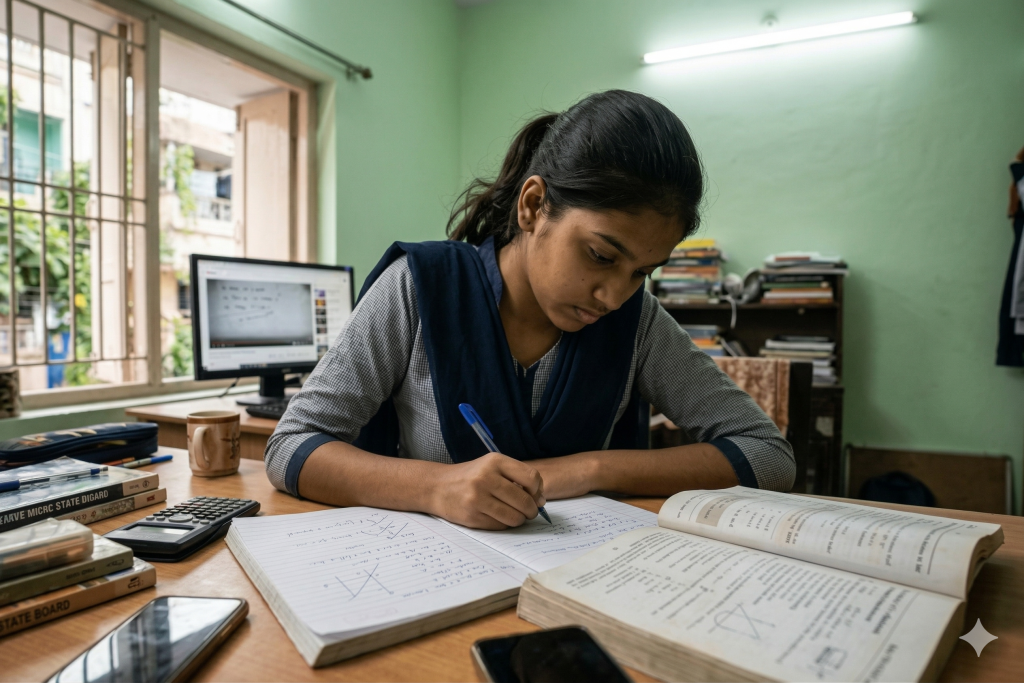
Tamil Nadu SSLC Maths Exam 2026 LIVE
05 00 PM IST - 25 Mar'26
Focus Shifts to Science
With the Maths answer key discussions winding down, students are now transitioning to prepare for the Science exam scheduled for March 30. DGE portal traffic remains high as students download the question paper PDF for record-keeping.
04 00 PM IST - 25 Mar'26
Passing Marks Reminder
As students evaluate their performance, teachers remind everyone that a minimum of 35/100 is required to pass. Many students are projecting scores in the 75–85 range based on the unofficial keys.
03 00 PM IST - 25 Mar'26
Detailed Paper Analysis Available.
Experts suggest the 2026 paper was well-balanced. While Algebra and Geometry were slightly time-consuming, the Trigonometry and Statistics sections were direct and scoring, keeping the overall difficulty at "Moderate."
01 55 PM IST - 25 Mar'26
Unofficial Answer Key Released.
Our subject experts have released the preliminary answer keys. Students can now cross-check their Part I (MCQs) solutions to estimate their scores.
01 30 PM IST - 25 Mar'26
Unofficial Answer Key & Student Reactions Coming Up Shortly
Our coverage continues. The unofficial answer key, paper analysis, and first student reactions will be shared shortly. Stay tuned to the live blog.
01 15 PM IST - 25 Mar'26
Tamil Nadu SSLC Maths Exam 2026 Ends!
The exam has concluded. Students are now exiting exam halls across centres.
01 00 PM IST - 25 Mar'26
Final Minutes Left
The exam is nearing its end. Students are in the final phase of attempting and revising their answers.
12 00 PM IST - 25 Mar'26
Halfway Through the Exam
The exam has crossed the halfway mark. Students continue writing as the paper progresses smoothly.
11 00 AM IST - 25 Mar'26
Exam in Progress
The exam is currently underway across centres. Students are attempting different sections of the question paper.
10 00 AM IST - 25 Mar'26
Tamil Nadu SSLC Maths Exam 2026 Begins!
The exam has officially started. Students have entered the exam halls and the paper is now in progress.
09 00 AM IST - 25 Mar'26
Students Gathered Near Exam Centres
A large number of students have reached their exam centres. Entry procedures are underway, and students are waiting outside before being allowed inside.
08 00 AM IST - 25 Mar'26
Students Leaving Homes
Students are now stepping out for the exam, carrying their hall tickets and essential items. Parents are accompanying many students to the centres.
07 00 AM IST - 25 Mar'26
Morning Traffic Alert!
Students are advised to leave early as there may be morning traffic in many areas. Plan your travel in advance and make sure you reach the exam centre on time.
06 00 AM IST - 25 Mar'26
Good morning, students! Exam Day is Here
Good morning! The Tamil Nadu SSLC Maths Exam 2026 day is finally here. Stay calm, revise your formulas once, and start your day with a positive mindset. You’ve prepared well, now trust yourself.
05 00 AM IST - 25 Mar'26
Important 8-Mark Question - 5
(a) Construct a ∆ABC such that AB = 5.5 cm, ∠C = 25° and the altitude from C to AB is 4 cm.
OR
(b) Draw the two tangents from a point which is 5 cm away from the centre of a circle of diameter 6 cm. Also, measure the lengths of the tangents.
04 00 AM IST - 25 Mar'26
Important 8-Mark Question - 4
(a) Varshika drew 6 circles with different sizes. Draw a graph for the relationship between the diameter and circumference (approximately related) of each circle as shown in the table and use it to find the circumference of a circle when its diameter is 6 cm.
Diameter (x) cm: 1, 2, 3, 4, 5
Circumference (y) cm: 3.1, 6.2, 9.3, 12.4, 15.5OR
(b) Draw the graph of y = x² − 5x − 6 and hence solve x² − 5x − 14 = 0.03 00 AM IST - 25 Mar'26
Important 8-Mark Question - 3
(a) Take a point which is 11 cm away from the centre of a circle of radius 4 cm and draw two tangents to the circle from that point.
OR
(b) Draw a triangle ABC of base BC = 8 cm, ∠A = 60° and the bisector of ∠A meets BC at D such that BD = 6 cm.
02 00 AM IST - 25 Mar'26
Important 8-Mark Question - 2
(a) Draw the graph of y = 2x² − 3x − 5 and hence solve 2x² − 4x − 6 = 0.
OR
(b) Draw the graph of xy = 24, x, y > 0. Using the graph find,
(i) y when x = 3 and(ii) x when y = 6.
01 00 AM IST - 25 Mar'26
Important 8-Mark Question - 1
(a) Construct a ∆PQR in which the base PQ = 4.5 cm, ∠R = 35° and the median RG from R to PQ is 6 cm.
OR
(b) Draw a circle of diameter 6 cm. From a point P, which is 8 cm away from its centre, draw the two tangents PA and PB to the circle and measure their lengths.12 00 AM IST - 25 Mar'26
8-Mark Questions to Practice
In the upcoming updates, we will share important 8-mark questions for practice to help you strengthen concepts and improve your scores. Stay tuned to the live blog and keep checking for these high-weightage questions.
11 30 PM IST - 24 Mar'26
What not to do right now?
Don’t start anything new or overthink what you already know. Avoid panic and last-minute cramming - it will only confuse you. Just relax, trust your preparation, and get proper sleep.
11 00 PM IST - 24 Mar'26
Essentials Checklist for Tomorrow’s Exam
- Admit card + valid ID proof (keep them in your bag right now)
- Stationery: pens, pencils, erasers
- Scale (bring the transparent one; steel scales have formulas written on the back, and they’re often rejected during security checks)
- Transparent water bottle
- Watch (if permitted)
- Comfortable clothes ready
- Exam centre location checked
- Set 2 alarms and keep a backup
10 30 PM IST - 24 Mar'26
Statistics Important Formulas to Revise - 2
Mode (Grouped Data):
Mode = l + [ (f₁ − f₀) / (2f₁ − f₀ − f₂) ] × h
(Where l = lower limit, f₁ = modal class frequency, f₀ = preceding, f₂ = succeeding, h = class width)Median (Grouped Data):
Median = l + [ (n/2 − cf) / f ] × h
(Where l = lower limit, cf = cumulative frequency before median class, f = frequency, h = class width)Cumulative Frequency (CF):
CF = Running total of frequencies
(Used to find the median and draw the ogive)Total Frequency:
Σf = Total number of observationsMean Deviation (Basic Idea):
Mean Deviation = Σ|x − x̄| / n
10 00 PM IST - 24 Mar'26
Statistics Important Formulas to Revise - 1
Arithmetic Mean (Ungrouped Data):
Mean (x̄) = Σx / n
(Where Σx = sum of observations, n = number of observations)Arithmetic Mean (Discrete Frequency):
Mean (x̄) = Σfx / Σf
(Where f = frequency, x = value)Mean for Grouped Data (Assumed Mean Method):
x̄ = a + (Σfd / Σf)
(Where a = assumed mean, d = deviation)Class Mark (Mid Value):
Range:
Class mark = (Upper limit + Lower limit) / 2
(Used in grouped data calculations)
Range = Highest value − Lowest value09 30 PM IST - 24 Mar'26
Some More Graph/Draw Questions to Practice
- Draw a triangle ABC of base BC=8 cm, ∠A=60° and the bisector of ∠A meets BC at D such that BD=6 cm.
- Take a point which is 11 cm away from the centre of a circle of radius 4 cm and draw the two tangents to the circle from that point.
09 00 PM IST - 24 Mar'26
Graph Questions to Practice
- Graph the quadratic equation x²−9x+20=0 and state the nature of the solution.
- A bus is travelling at a uniform speed of 50 km/hr. Draw the distance-time graph and hence find:
(i) the constant of variation
(ii) how far will it travel in 90 minutes?
(iii) the time required to cover a distance of 300 km.
08 30 PM IST - 24 Mar'26
1-Mark Solved Questions - 4
In the table below are some more solved MCQs for maths practice:
Question
Options
Correct Answer
If (x−6) is the H.C.F of x²−2x−24 and x²−kx−6, then the value of k is :
(a) 3 (b) 5 (c) 6 (d) 8
(b) 5
Transpose of a column matrix is :
(a) unit matrix (b) diagonal matrix (c) column matrix (d) row matrix
(d) row matrix
A tangent is perpendicular to the radius of a circle at the :
(a) Centre (b) Point of Contact (c) Infinity (d) Chord
(b) Point of Contact
The equation of a line passing through the origin and parallel to the line 7x−3y+4=0 is :
(a) 7x−3y+4=0 (b) 3x−7y+4=0 (c) 3x+7y=0 (d) 7x−3y=0
(d) 7x−3y=0
08 00 PM IST - 24 Mar'26
1-Mark Solved Questions - 3
Given below are a few solved 1-mark MCQs:
Question
Options
Correct Answer
The range of the relation R={(x, x²) | x is a prime number less than 13} is :
(a) {2, 3, 5, 7} (b) {2, 3, 5, 7, 11} (c) {4, 9, 25, 49, 121} (d) {1, 4, 9, 25, 49, 121}
(c) {4, 9, 25, 49, 121}
Let n(A)=m and n(B)=n, then the total number of functions that exist from B to A is :
(a) mⁿ (b) nᵐ (c) 2^(mn−1) (d) 2^(mn)
(a) mⁿ
Euclid’s division lemma states that for positive integers a and b, there exist unique positive integers q and r such that a=bq+r, where r must satisfy.
(a) 1 < r < b (b) 0 < r < b (c) 0 ≤ r < b (d) 0 < r ≤ b
(c) 0 ≤ r < b
If 6 times of 6th term of an A.P. is equal to 7 times the 7th term, then the 13th term of the A.P. is :
(a) 0 (b) 6 (c) 7 (d) 13
(a) 0
07 30 PM IST - 24 Mar'26
1-Mark Solved Questions - 2
You can check some more important solved MCQs below:
Question
Options
Correct Answer
How many tangents can be drawn to the circle from an exterior point ?
(a) One (b) Two (c) Infinite (d) Zero
(b) Two
The area of triangle formed by the points (−5, 0), (0, −5) and (5, 0) is :
(a) 0 sq. units (b) 25 sq. units (c) 5 sq. units (d) 10 sq. units
(b) 25 sq. units
If x=a tanθ and y=b secθ, then :

07 00 PM IST - 24 Mar'26
1-Mark Solved Questions - 1
You can check out some solved MCQs below for your practice:
Question
Options
Correct Answer
If n(A×B)=6 and A={1, 3}, then n(B) is :
(a) 1 (b) 2 (c) 3 (d) 6
(c) 3
If f :A→B is a bijective function and if n(B)=7, then n(A) is equal to :
(a) 7 (b) 49 (c) 1 (d) 14
(a) 7
The least number that is divisible by all the numbers from 1 to 10 (both inclusive) is :
(a) 2025 (b) 5220 (c) 5025 (d) 2520
(d) 2520
An A.P. consists of 31 terms. If its 16th term is m, then the sum of all the terms of this A.P. is :
(a) 16 m (b) 62 m (c) 31 m (d) 31/2 m
(c) 31 m
Which of the following should be added to make x⁴+64 a perfect square ?
(a) 4x² (b) 16x² (c) 8x² (d) −8x²
(b) 16x²
Graph of a linear equation is a __________.
(a) straight line (b) circle (c) parabola (d) hyperbola
(a) straight line
If in ∆ABC, DE ∥ BC, AB=3.6 cm, AC=2.4 cm and AD=2.1 cm then the length of AE is :
(a) 1.4 cm (b) 1.8 cm (c) 1.2 cm (d) 1.05 cm
(a) 1.4 cm
06 40 PM IST - 24 Mar'26
Probability Important Formulas - 3
Multiplication Rule (Independent Events):
P(A ∩ B) = P(A) × P(B)
(When the occurrence of one does not affect the other)Probability of “At least one”:
P(at least one event) = 1 − P(none)
(Useful shortcut in many questions)Total Outcomes Concept:
If n(S) = total outcomes and n(E) = favourable outcomes,
then P(E) = n(E) / n(S)
(Basic idea behind most probability problems)
06 20 PM IST - 24 Mar'26
Probability Important Formulas - 2
Sure Event:
P(E) = 1
(Event that will definitely happen)Addition Rule (Mutually Exclusive Events):
P(A ∪ B) = P(A) + P(B)
(Used when A and B cannot happen together)Addition Rule (General Case):
P(A ∪ B) = P(A) + P(B) − P(A ∩ B)
(Used when A and B may happen together)
06 00 PM IST - 24 Mar'26
Probability Important Formulas - 1
Basic Probability Formula:
P(E) = Number of favourable outcomes / Total number of outcomes
(Used when all outcomes are equally likely)Range of Probability:
0 ≤ P(E) ≤ 1
(Probability can never be negative or more than 1)Complementary Event:
P(E̅) = 1 − P(E)
(Probability that an event does NOT happen)Impossible Event:
P(E) = 0
(Event that cannot happen, for example, getting 7 on a die)
05 40 PM IST - 24 Mar'26
Probability Practice Questions
- The total marks scored by two students, Sathya and Vidhya, in 5 subjects are 460 and 480, with standard deviations of 4.6 and 2.4, respectively. Who is more consistent in performance?
- A bag contains 5 red balls, 6 white balls, 7 green balls, and 8 black balls. One ball is drawn at random from the bag. Find the probability that the ball drawn is
(i) white
(ii) black or red
(iii) not white
(iv) neither white nor black
05 20 PM IST - 24 Mar'26
Probability Important Solved Question - 2
A flower is selected at random from a basket containing 80 yellow, 70 red and 50 white flowers. Find the probability of selecting a yellow coloured flower.
Total number of flowers = 80 + 70 + 50 = 200
Probability of selecting a yellow flower = Number of yellow flowers / Total flowers
= 80 / 200
= 2 / 5Answer: Probability = 2/5
05 00 PM IST - 24 Mar'26
Probability Important Solved Question - 1
Find the range of the following distribution :
Age (in years): 16-18, 18-20, 20-22, 22-24, 24-26, 26-28
Number of Students: 0, 4, 6, 8, 2, 2
Age (in years): 16–18, 18–20, 20–22, 22–24, 24–26, 26–28
Range = Highest value − Lowest value
Highest value = 28
Lowest value = 16Range = 28 − 16 = 12
Answer: Range = 12 years
04 40 PM IST - 24 Mar'26
Mensuration Important Formulas - 3
Volume of Cylinder:
V = πr²hVolume of Cone:
V = (1/3)πr²hCurved Surface Area of Frustum of Cone:
CSA = πl(R + r)
04 20 PM IST - 24 Mar'26
Mensuration Important Formulas - 2
Surface Area of Cube:
TSA = 6a²Volume of Cube:
V = a³Volume of Cuboid:
V = l × b × h
04 00 PM IST - 24 Mar'26
Mensuration Important Formulas - 1
Area of Rectangle:
Area = length × breadthArea of Triangle:
Area = 1/2 × base × heightArea of Circle:
Area = πr²Circumference of Circle:
C = 2πr
03 40 PM IST - 24 Mar'26
Mensuration Practice Questions
- Nathan, an engineering student, was asked to make a model shaped like a cylinder with two cones attached at its two ends. The diameter of the model is 3 cm, and its length is 12 cm. If each cone has a height of 2 cm, find the volume of the model that Nathan made.
- A metallic sphere of radius 16 cm is melted and recast into small spheres, each of radius 2 cm. How many small spheres can be obtained?
03 20 PM IST - 24 Mar'26
Some More Mensuration Solved Questions
If the ratio of radii of two spheres is 4 : 7, find the ratio of their volumes.
Volume of sphere ∝ r³
So, ratio of volumes = 4³ : 7³
= 64 : 343The slant height of a frustum of a cone is 5 cm and the radii of its ends are 4 cm and 1 cm. Find its curved surface area.
Formula:
CSA of frustum = πl(R + r)= π × 5 × (4 + 1)
= π × 5 × 5
= 25π
03 00 PM IST - 24 Mar'26
Mensuration Important Solved Question
From the top of a rock 50√3 m high, the angle of depression of a car on the ground is 30°. Find the distance of the car from the rock.
Height = 50√3 m
Angle of depression = 30°Angle of elevation = 30°
tan 30° = height / distance
1/√3 = (50√3) / d
Cross multiply:
d = 50√3 × √3
d = 50 × 3
d = 150 mAnswer: Distance = 150 m
02 40 PM IST - 24 Mar'26
Numbers & Sequences Important Formulas - 3
Sum of squares of first n natural numbers:
1² + 2² + 3² + … + n² = n(n + 1)(2n + 1)/6Sum of cubes of first n natural numbers:
1³ + 2³ + 3³ + … + n³ = [n(n + 1)/2]²Euclid’s Division Lemma:
For any integers a and b (b ≠ 0):
a = bq + r, where 0 ≤ r < b
02 20 PM IST - 24 Mar'26
Numbers & Sequences Important Formulas - 2
nth term from the end of A.P.:
aₙ = l − (n − 1)dCondition for a number to be the middle term of A.P.:
Middle term = (first term + last term)/2Sum of first n natural numbers:
1 + 2 + 3 + … + n = n(n + 1)/2
02 00 PM IST - 24 Mar'26
Numbers & Sequences Important Formulas - 1
General form of A.P.:
a, a + d, a + 2d, a + 3d, …nth term of A.P.:
aₙ = a + (n − 1)dSum of first n terms of A.P.:
Sum of first n terms (alternative form):
Sₙ = n/2 [2a + (n − 1)d]
Sₙ = n/2 (a + l)
(where l = last term)01 40 PM IST - 24 Mar'26
Numbers & Sequences Solved Question - 3
Check whether the sequence 2, 8, 18, 32, 50, … is an A.P or not? If it is an A.P, then find the common difference.
Find differences:
8 − 2 = 6
18 − 8 = 10
32 − 18 = 14
50 − 32 = 18Since differences are not equal, the sequence is not an A.P.
01 20 PM IST - 24 Mar'26
Numbers & Sequences Solved Question - 2
A man has 532 flower pots. He wants to arrange them in rows such that each row contains 21 flower pots. Find the number of completed rows and how many flower pots are left over.
Number of rows = 532 ÷ 21
21 × 25 = 525
Remainder = 532 − 525 = 7
Answer:
Number of completed rows = 25
Flower pots left over = 7
01 00 PM IST - 24 Mar'26
Numbers & Sequences Solved Question - 1
Let A={1, 2, 3} and B={ x | x is a prime number less than 10}. Find A×B.
Prime numbers less than 10 = {2, 3, 5, 7}
So, B = {2, 3, 5, 7}
A × B = {(a, b) | a ∈ A, b ∈ B}
= {(1,2), (1,3), (1,5), (1,7),
(2,2), (2,3), (2,5), (2,7),
(3,2), (3,3), (3,5), (3,7)}A × B = {(1,2), (1,3), (1,5), (1,7), (2,2), (2,3), (2,5), (2,7), (3,2), (3,3), (3,5), (3,7)}
12 40 PM IST - 24 Mar'26
Angle Bisector Theorem & its Proof
In a triangle, the angle bisector of a triangle divides the opposite side in the ratio of the sides containing the angle.
In ΔABC, if AD is the bisector of ∠A meeting BC at D, then:
AB / AC = BD / DCProof:
In ΔABC, AD is the bisector of ∠A.
So, ∠BAD = ∠CADDraw perpendiculars from B and C to AD, meeting AD at E and F respectively.
In ΔABD and ΔACD,
Area of ΔABD = (1/2) × BD × BE
Area of ΔACD = (1/2) × DC × CFSo, Area of ΔABD / Area of ΔACD = (BD × BE) / (DC × CF) ...(1)
But BE = CF (perpendicular distances from B and C to AD are equal because triangles have equal angles at A)
So, Area of ΔABD / Area of ΔACD = BD / DC ...(2)
Also, Area of ΔABD / Area of ΔACD = AB / AC ...(3)
From (2) and (3):
AB / AC = BD / DC12 20 PM IST - 24 Mar'26
Geometry Important Formulas - 2
Slope of a Line:
m = (y₂ − y₁) / (x₂ − x₁)Condition for Collinearity:
Three points are collinear if area of triangle formed = 0Angle Sum Property of Triangle:
Sum of interior angles of a triangle = 180°Exterior Angle Property:
Exterior angle = sum of two opposite interior angles
12 00 PM IST - 24 Mar'26
Geometry Important Formulas - 1
Pythagoras Theorem:
In a right triangle,
(hypotenuse)² = (base)² + (height)²Distance Formula:
Distance between (x₁, y₁) and (x₂, y₂) = √[(x₂ − x₁)² + (y₂ − y₁)²]Section Formula (Internal Division):
Point dividing line joining (x₁, y₁) and (x₂, y₂) in ratio m:n is:
( (mx₂ + nx₁)/(m+n), (my₂ + ny₁)/(m+n) )Area of Triangle (Coordinate Geometry):
Area = 1/2 | x₁(y₂ − y₃) + x₂(y₃ − y₁) + x₃(y₁ − y₂) |
11 40 AM IST - 24 Mar'26
Geometry Important Solved Question - 3
The line through the points (−2, a) and (9, 3) has slope −1/2. Find the value of ‘a’.
Given:
Points: (−2, a) and (9, 3)
Slope = −1/2Using slope formula:
m = (y₂ − y₁) / (x₂ − x₁)−1/2 = (3 − a) / (9 − (−2))
−1/2 = (3 − a) / 11
Cross multiply:
−1 × 11 = 2(3 − a)
−11 = 6 − 2aSolve:
−11 − 6 = −2a
−17 = −2aa = 17/2
Answer: a = 17/2
11 20 AM IST - 24 Mar'26
Geometry Important Solved Question - 2
Find the value of k, if the area of a quadrilateral is 28 sq. units, whose vertices are taken in the order (−4, −2), (−3, k), (3, −2) and (2, 3).
Given:
Vertices of quadrilateral: (−4, −2), (−3, k), (3, −2), (2, 3)
Area = 28 sq. unitsUsing Shoelace Formula:
Area = 1/2 | x₁y₂ + x₂y₃ + x₃y₄ + x₄y₁ − (y₁x₂ + y₂x₃ + y₃x₄ + y₄x₁) |
Substitute values:
= 1/2 | (−4)(k) + (−3)(−2) + (3)(3) + (2)(−2) − [ (−2)(−3) + k(3) + (−2)(2) + (3)(−4) ] |
= 1/2 | −4k + 6 + 9 − 4 − (6 + 3k − 4 − 12) |
= 1/2 | (−4k + 11) − (3k − 10) |
= 1/2 | −4k + 11 − 3k + 10 |
= 1/2 | −7k + 21 |
Given area = 28:
1/2 | −7k + 21 | = 28
| −7k + 21 | = 56
Case 1:
−7k + 21 = 56
−7k = 35
k = −5Case 2:
Answer: k = −5 or k = 11
−7k + 21 = −56
−7k = −77
k = 1111 00 AM IST - 24 Mar'26
Geometry Important Solved Question - 1
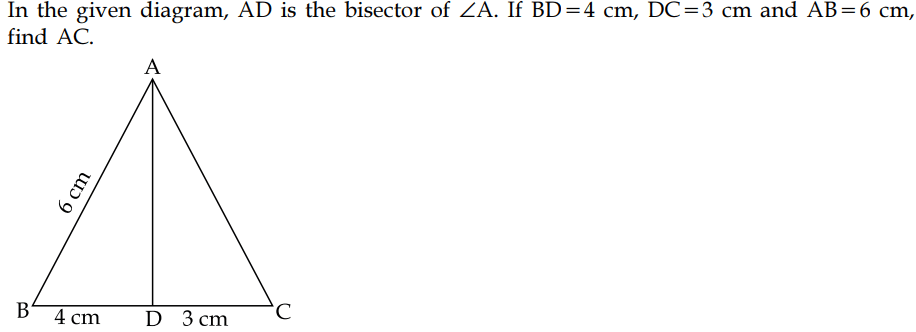
Given:
AD is the angle bisector of ∠A
BD = 4 cm, DC = 3 cm, AB = 6 cmTo find: AC
Using Angle Bisector Theorem:
AD / AD ⇒ AB / AC = BD / DC
So, AB / AC = BD / DC
6 / AC = 4 / 3
Cross multiply:
6 × 3 = 4 × AC
18 = 4ACAC = 18 / 4
AC = 4.5 cmAnswer: AC = 4.5 cm
10 40 AM IST - 24 Mar'26
Algebra Important Formulas - 3
Discriminant:
D = b² − 4acIf D > 0 → Real and distinct roots
If D = 0 → Real and equal roots
If D < 0 → Imaginary rootsLaws of Exponents:
aᵐ × aⁿ = aᵐ⁺ⁿ
aᵐ / aⁿ = aᵐ⁻ⁿ
(aᵐ)ⁿ = aᵐⁿ
a⁰ = 1 (a ≠ 0)
a⁻ⁿ = 1 / aⁿ
10 20 AM IST - 24 Mar'26
Algebra Important Formulas - 2
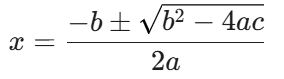
The Quadratic Formula
Sum and Product of Roots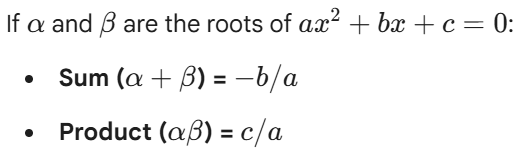
10 00 AM IST - 24 Mar'26
Algebra Important Formulas - 1
Some basic formulas are:
1. (a + b)² = a² + 2ab + b²
2. (a − b)² = a² − 2ab + b²
3. (a + b)(a − b) = a² − b²
4. (a + b)³ = a³ + 3a²b + 3ab² + b³
5. (a − b)³ = a³ − 3a²b + 3ab² − b³
6. a³ + b³ = (a + b)(a² − ab + b²)
7. a³ − b³ = (a − b)(a² + ab + b²)
09 40 AM IST - 24 Mar'26
Algebra Important Solved Question - 3
Let f : A → B be a function defined by f(x)=x/2−1, where
A={2, 4, 6, 10, 12}, B={0, 1, 2, 4, 5, 9}. Represent f by
(i) set of ordered pairs
(ii) a table
(iii) an arrow diagram
(i) Table:
x = 2, f(x) = −1/5
x = 4, f(x) = 3/5
x = 6, f(x) = 7/5
x = 10, f(x) = 3
x = 12, f(x) = 19/5(ii) Ordered pairs:
{(2,−1/5), (4,3/5), (6,7/5), (10,3), (12,19/5)}(iii) Arrow diagram:
2 → −1/5
4 → 3/5
6 → 7/5
10 → 3
12 → 19/5
09 20 AM IST - 24 Mar'26
Algebra Important Solved Question - 2
Show that the straight lines x−2y+3=0 and 6x+3y+8=0 are perpendicular.
x−2y+3=0 ⇒ y = (1/2)x + 3/2 ⇒ m₁ = 1/2
6x+3y+8=0 ⇒ y = −2x − 8/3 ⇒ m₂ = −2
m₁ × m₂ = (1/2)(−2) = −1
Answer: The lines are perpendicular.
09 00 AM IST - 24 Mar'26
Algebra Important Solved Question - 1
Find f o g and g o f when f(x)=2x+1 and g(x)=x²−2.
f(g(x)) = f(x²−2) = 2(x²−2)+1 = 2x²−4+1 = 2x²−3
g(f(x)) = g(2x+1) = (2x+1)²−2 = 4x²+4x+1−2 = 4x²+4x−1
Answer:
f o g = 2x²−3
g o f = 4x²+4x−108 20 AM IST - 24 Mar'26
How to Get the "Extra Edge" for More Marks
To impress the examiner and secure every possible mark, follow these presentation hacks:
- For every 2 and 5-mark question, clearly write the "Given" data first, then the "Formula" used in a box, and finally the "Result" with its proper unit. Examiners love this structure.
- Never do rough calculations in the margins or on the last page. Draw a neat vertical line on the right side of every page and do your work there. It shows the examiner your thought process.
- Even if you think you might get the final answer wrong, write down every logical step and the relevant formula. In the Tamil Nadu board, you can still get 3 or 4 marks out of 5 just for the correct steps.
- If you make a mistake, don't scribble over it. Just draw a single neat line through it and rewrite. A clean paper often gets a more "generous" evaluation.
08 00 AM IST - 24 Mar'26
Time Allocation Strategy
Some maths toppers have suggested using the following strategy to divide the overall time:
Part
Suggested time
Purpose
Section A & B (1 & 2 marks)
45 minutes
Quickly finish short and direct questions
Section C (5 marks)
75 minutes
Write full steps and clear solutions
Section D (8 marks)
30 minutes
Attempt higher weightage questions
Revision
Last 30 minutes of the exam
Cross-check answers and calculations
07 40 AM IST - 24 Mar'26
How to use 15 Minute reading time effectively
Use the initial reading time to identify the Compulsory Questions (Q. No. 28 and 42). If they look tricky, use this time to mentally map out the formula you'll need so you don't panic later.
07 20 AM IST - 24 Mar'26
Expert Preparation Tips
You can follow some prep tips by subject matter experts that we have listed below:
- Maintaining a small notebook where you record only the mistakes you make during practice is a game changer. Reviewing this for 15 minutes a day ensures you don't repeat the same calculation errors in the actual exam.
- While exercise sums are great, the board often picks "Example" problems directly from the textbook for the 5 mark section. Make sure you've solved every single one of them.
- Practicing tables up to 20 and squares up to 30 will save you precious minutes during the exam, especially in chapters like Mensuration and Statistics.
07 00 AM IST - 24 Mar'26
Expected Chapter-Wise Weightage
The exam usually includes 44 questions divided into four sections: 1 mark multiple choice, 2 mark short answers, 5 mark long answers, and 8 mark practical questions (Geometry and Graphs).
Chapter Name
Expected Marks Range
Important Topics
Relations and Functions
8 - 10 Marks
Composition of functions, f(g(x)), and basic definitions.
Numbers and Sequences
12 - 14 Marks
Arithmetic Progression (AP) and Geometric Progression (GP) sums.
Algebra
24 - 28 Marks
Solving linear equations, Square roots of polynomials, and Graphs (8 Marks).
Geometry
18 - 22 Marks
Pythagoras & Thales Theorems, and Practical Geometry (8 Marks).
Coordinate Geometry
8 - 10 Marks
Area of a quadrilateral and triangle, and straight line equations.
Trigonometry
8 - 10 Marks
Heights and distances (angles of elevation/depression).
Mensuration
10 - 12 Marks
Surface area and volume of cones, cylinders, and spheres.
Statistics and Probability
10 - 12 Marks
Standard deviation, Coefficient of variation, and Probability of events.
06 40 AM IST - 24 Mar'26
Mathematics Exam Pattern
Tamil Nadu 10th maths question paper is divided into four parts. Part I carries 1 mark questions, Part II includes short answer questions, Part III has longer answers, and Part IV includes high-weightage questions. The total marks for the paper are 100, and the duration is 3 hours.
06 20 AM IST - 24 Mar'26
Hall Ticket Reminder
Do not forget to carry your Tamil Nadu SSLC hall ticket to the exam centre. Without it, entry will not be allowed.
06 00 AM IST - 24 Mar'26
Tamil Nadu SSLC Maths Exam 2026 Exam Date & Timings
The maths exam will be held on March 25, 2026. It will take place from 10:00 AM to 1:15 PM. You can check the distribution of the duration below:
Time period
Activity
10:00 a.m to 10:10 a.m
Reading the question paper
10:10 a.m to 10:15 a.m
Verification of particulars by the candidate
10:15 a.m to 1:15 p.m
Duration of the examination